Seasonal perimeter insect barrier treatments establish a continuous chemical and mechanical buffer around the exterior footprint of a structure, eliminating pests before they breach wall voids or living spaces. In…
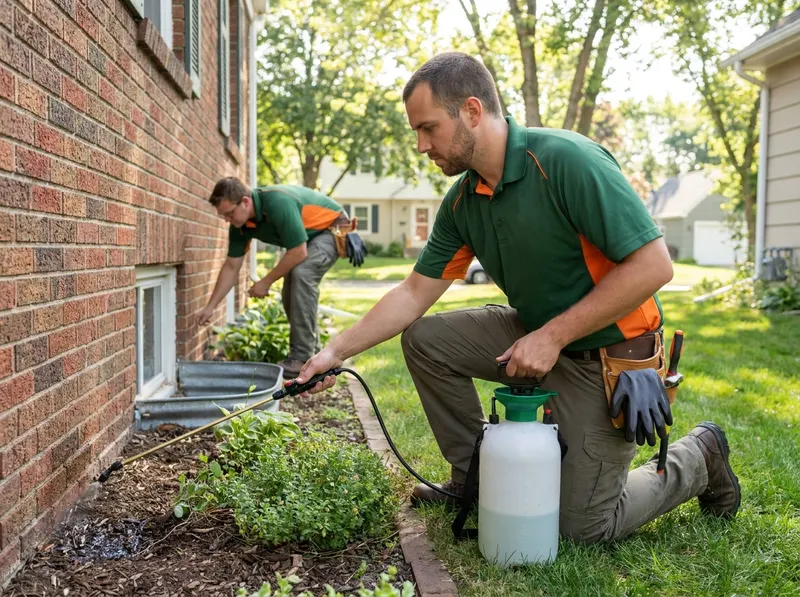
Seasonal perimeter insect barrier treatments establish a continuous chemical and mechanical buffer around the exterior footprint of a structure, eliminating pests before they breach wall voids or living spaces. In mature neighborhoods like Linden Hills, Bryn Mawr, and Lynnhurst, dense tree canopies, damp soils near Lake Harriet, and original stone or block foundations create corridors for moisture-seeking carpenter ants and spiders. Applying microencapsulated formulations to the bottom 3 feet of exterior foundation masonry and 3 feet outward onto the soil creates an invisible zone where crawling insects pick up active ingredients on their cuticles. This treatment targets natural exterior pathways without saturating indoor nursery rooms, kitchens, or pet areas with chemical sprays.
In older wood-frame homes throughout Whittier, Longfellow, and Powderhorn Park, temperature drops in September trigger mass migrations of boxelder bugs and western conifer seed bugs seeking winter shelter beneath exterior clapboards. A perimeter barrier applied in late spring and early autumn intercepts these biological shifts. Modern non-repellent micro-suspensions bind tightly to porous surfaces like St. Paul brick, poured concrete, and river stone foundations commonly found along the Mississippi River Gorge. Because the formulation is non-repellent, insects cross it unknowingly, preventing the scattering behavior where insects disperse deeper into structural wall cavities.
For dense urban lots and converted masonry warehouses in the North Loop and Northeast Minneapolis, zero-lot-line walls and concrete aprons require targeted exterior crack injection rather than wide turf broadcast. Perimeter applications fit properties experiencing recurring seasonal entries along foundation sills, basement hopper windows, and plumbing penetrations. When interior insect populations are already established and breeding within floor joists, an exterior barrier serves as an intercepting containment measure, though supplemental interior targeted exclusion or baiting is necessary to resolve internal nesting nodes.
Every job gets a firm, written price after a free on-site visit.
Tell us about your seasonal perimeter insect barrier job in Minneapolis and we'll send a clear, written quote, usually the same day.
 Crovella Bug Services